Setting up a home gym makes it easier to maintain a consistent fitness routine by eliminating commuting time, crowded facilities, and equipment wait times. Whether you have a garage, basement, or spare room, a carefully selected collection of versatile equipment can provide an effective space for full-body workouts.
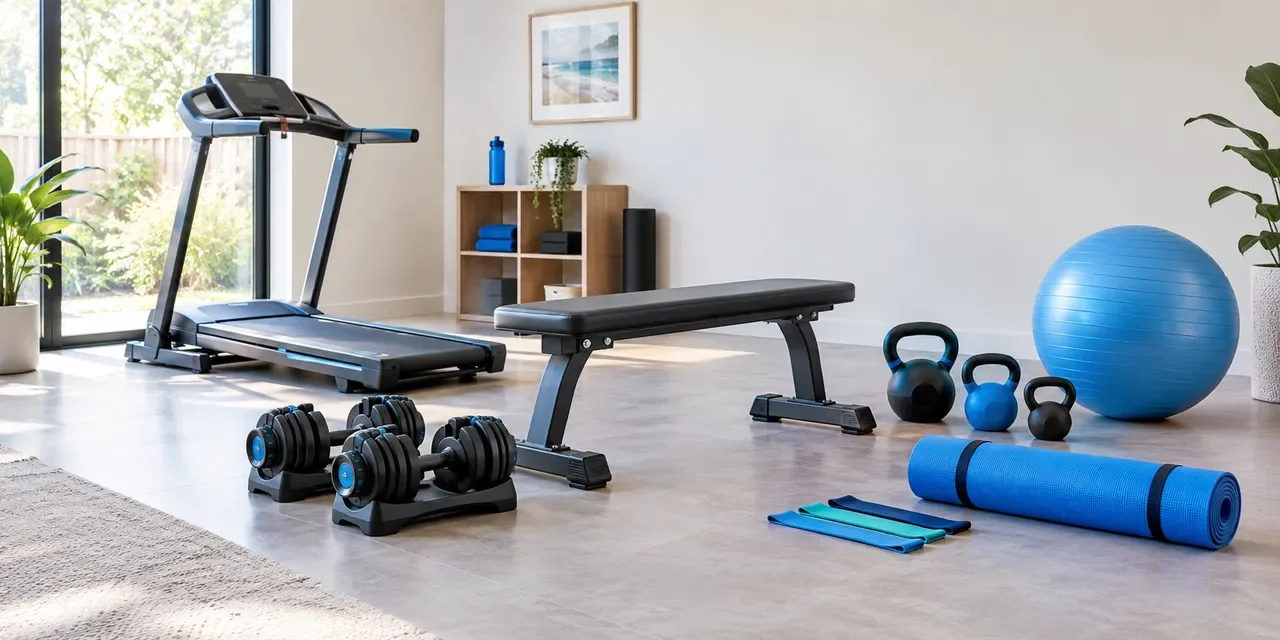
You don’t need to spend thousands of dollars on commercial-grade fitness machines to achieve meaningful results. With a few essential pieces of equipment, you can build a practical workout space that supports strength training, mobility exercises, and general fitness. A home gym can also reduce recurring membership and transportation costs while giving you greater flexibility over your workout schedule.
Home Gym vs. Commercial Gym: Key Differences
Commercial gyms offer a wide range of specialized machines, heavy weights, and opportunities to exercise alongside other people. However, membership fees, commuting time, busy facilities, and operating hours may make regular visits less convenient.
A home gym offers a different set of advantages:
| Feature | Commercial Gym | Home Gym |
|---|---|---|
| Equipment access | Equipment may be occupied during busy periods. | Your equipment is available when you need it. |
| Travel time | Requires commuting to and from the facility. | No commute is necessary. |
| Ongoing costs | May involve membership and initiation fees. | Requires an initial equipment investment and possible maintenance costs. |
| Scheduling | Depends on facility hours and availability. | Offers greater flexibility around your daily routine. |
| Workout environment | Shared space with other members. | A personalized environment with your preferred music and setup. |
For many people, having workout equipment at home makes exercise more convenient. By reducing the time and effort required to get started, a home gym can help make regular physical activity easier to maintain.
Essential Equipment for an Efficient Home Gym
An effective home gym doesn’t need to be large or complicated. The best approach is to prioritize versatile equipment that supports multiple exercises while fitting comfortably within your available space.
1. Adjustable Dumbbells
<em>Adjustable dumbbells are a space-efficient foundation for strength training.</em>
Adjustable dumbbells replace multiple pairs of fixed weights with a single compact set. Depending on the model, you can change the resistance using a dial, pin, or locking mechanism, making it easier to transition between exercises.
They support a wide variety of movements, including goblet squats, lunges, dumbbell rows, chest presses, shoulder presses, and biceps curls. This versatility makes them suitable for beginners and experienced lifters alike.
When choosing adjustable dumbbells, consider the available weight range, adjustment mechanism, grip comfort, durability, and storage requirements. Select a set that accommodates your current strength while allowing room for progression.
2. High-Density Exercise Mat
An exercise mat provides cushioning and traction for floor-based workouts, making it useful for stretching, core exercises, push-ups, yoga, and mobility training.
Look for a mat with sufficient thickness for comfort without compromising stability during standing exercises. A non-slip surface is particularly helpful when performing movements that require balance or changes in position.
A mat can also help keep sweat away from the floor and define your workout area. However, standard exercise mats are not designed to protect flooring from heavy weights or repeated impacts. For those purposes, consider dedicated protective gym flooring.
3. Flat or Adjustable Utility Bench
A sturdy utility bench expands the range of exercises you can perform with dumbbells. It provides a stable platform for flat and incline chest presses, supported rows, seated shoulder presses, and certain lower-body exercises.
Flat benches are generally simpler and may be more affordable, while adjustable benches offer additional positioning options for greater exercise variety.
When selecting a bench, check its maximum weight capacity, frame construction, padding, stability, and, for adjustable models, the reliability of its locking mechanism. Make sure the bench fits comfortably within your workout area and provides adequate clearance for the exercises you plan to perform.
4. Doorway or Wall-Mounted Pull-Up Bar
A pull-up bar is a useful addition for developing upper-body pulling strength. Pull-ups and chin-ups engage the back, biceps, shoulders, and grip while requiring minimal floor space.
Depending on the model and your training level, a pull-up bar can also support hanging knee raises and other core exercises. Resistance bands may be used for assisted pull-ups, provided they are compatible with the setup and attached securely.
Before purchasing a doorway or wall-mounted bar, check the manufacturer’s installation instructions, weight limits, and compatibility with your door frame or wall structure. Improper installation can cause equipment failure or injury, so use the appropriate mounting hardware and follow all safety requirements.
5. Protective Rubber Gym Flooring
Protective gym flooring helps reduce wear on the underlying surface and provides a more suitable foundation for strength training. Rubber tiles or mats are often a practical choice for workout areas where dumbbells, benches, or other heavy equipment will be used.
The appropriate flooring depends on the type of training you plan to do. Thicker, denser rubber products may provide better protection against impacts than lightweight foam tiles, but performance varies by product and installation.
Before purchasing flooring, consider the weight of your equipment, the condition of the subfloor, moisture exposure, and noise concerns. Follow the flooring manufacturer’s recommendations, especially if you plan to lift heavy weights or perform high-impact exercises.
6. Resistance Bands
Resistance bands are affordable, portable, and versatile, making them an excellent addition to a compact home gym.
They can be used for rows, presses, glute exercises, mobility drills, warm-ups, and assisted pull-ups when the equipment is designed for that purpose. Different resistance levels allow you to adapt exercises to your current fitness level.
Choose bands that suit your intended exercises, and inspect them regularly for cracks, tears, or other signs of wear. If you attach a band to an anchor point, make sure the anchor is secure and appropriate for the intended load.
Smart Strategies for Building Your Home Gym
Choosing the right equipment is only part of the process. Organizing your space and planning your purchases carefully can help you build a safer, more functional workout environment.
-
Start with the fundamentals. Begin with adjustable dumbbells, resistance bands, and an exercise mat. Add a bench or other equipment as your training needs develop.
-
Prioritize versatile equipment. Choose items that support multiple exercises instead of investing immediately in large machines designed for a single movement.
-
Measure your available space. Check room dimensions, ceiling height, and equipment footprints before making purchases. Leave enough clear space to perform each exercise safely through its full range of motion.
-
Plan your flooring. Use a surface appropriate for your equipment and training style. Consider the needs of your subfloor, especially if you intend to lift heavy weights.
-
Keep equipment organized. Use suitable storage racks, wall hooks, or stands to prevent clutter and reduce tripping hazards. Store heavy items securely when they are not in use.
-
Prioritize safety. Follow equipment instructions, inspect moving parts and resistance bands, and ensure benches and pull-up bars are properly installed. Use appropriate technique and choose manageable resistance levels.
-
Expand gradually. Avoid buying everything at once. Identify your primary fitness goals first, then add equipment as your routine becomes more established.
Frequently Asked Questions
What equipment do you need for a basic home gym?
A basic home gym can start with adjustable dumbbells, resistance bands, an exercise mat, and enough clear floor space for your planned exercises. A utility bench and protective flooring can be added as your training needs grow.
How much space do you need for a home gym?
The space required depends on your equipment and workout routine. A small area may be sufficient for dumbbell exercises and floor workouts, while benches, racks, and larger machines require more room. Measure your space and follow the manufacturer’s clearance recommendations before purchasing equipment.
Is a home gym cheaper than a commercial gym?
A home gym can reduce recurring membership and commuting expenses, but it requires an initial investment in equipment and may involve maintenance or flooring costs. Whether it is more economical depends on how often you exercise, the equipment you need, and how long you plan to use it.
What is the best home gym equipment for beginners?
Adjustable dumbbells and resistance bands are versatile starting points for many beginners. An exercise mat can also be useful for mobility and floor exercises. Start with equipment that matches your fitness level and learn proper exercise technique before increasing resistance.
Do you need cardio equipment in a home gym?
Not necessarily. Walking, jogging, dancing, and other forms of bodyweight cardio can be performed without purchasing a machine. If you prefer indoor cardio, a jump rope, stationary bike, or treadmill may be worth considering based on your space, budget, and fitness goals.
The Practical Takeaway
Building an effective home gym doesn’t require a large room or a commercial-sized budget. By starting with versatile essentials such as adjustable dumbbells, resistance bands, an exercise mat, and suitable flooring, you can create a practical workout area that supports a variety of fitness goals.
The key is to choose equipment that fits your space, budget, and training needs. With thoughtful planning, safe equipment use, and a consistent routine, your home gym can become a convenient and sustainable part of your long-term fitness lifestyle.